
RAKHINE STATE, Myanmar: The Arakan Army announced on Friday, June 27, 2026, that fighting with Myanmar's military junta has intensified across multiple fronts in Rakhine State. But for Rohingya Muslim survivors, people who have lived through decades of state persecution, survived the 2017 genocide and now face a new cycle of atrocities at the hands of the Arakan Army, battlefield announcements carry a bitter familiarity. They have heard promises of order before. They have never seen justice.
AA Claims Military Advances, Unverified
In a statement issued on June 27, the Arakan Army said Myanmar's military is conducting daily airstrikes and attempting to advance into Gwa Township in southern Rakhine State by both land and sea. According to the AA, the military deployed more than 400 troops from Artillery Battalion 344 and units based in Pathein, Ayeyarwady Region.
The group claimed it successfully repelled the offensive and captured three strategic hill positions in Yegyi Township, including Point 288 on June 17, Point 188 on June 19, and Point 148 on June 21, seizing weapons, ammunition and military equipment in the process. The AA said active fighting is also continuing around Sittwe, Kyaukphyu, the Rakhine and Magway border, the Rakhine and Bago border, and in Chin State's Mindat and Kanpetlet townships.
These claims were made solely by the Arakan Army and have not been independently verified.
A Lifetime of Persecution Before 2017
To understand what Rohingya survivors are living through today, it is necessary to understand what came before. The 2017 genocide was not a sudden eruption of violence. It was the culmination of decades of systematic, state-engineered destruction of an entire people.
According to testimony gathered from Rohingya survivors, life in Myanmar before the mass exodus was defined by a campaign of disenfranchisement that touched every single aspect of daily existence. The 1982 Citizenship Law stripped the Rohingya of their nationality, rendering them stateless in the country of their birth. The government then forced the label "Bengali" onto them in official documents, a deliberate strategy to erase their indigenous identity and paint them as illegal immigrants from Bangladesh.
The discrimination was total. Homes, properties and belongings were gradually confiscated by the state, pushing thousands into Internally Displaced Person camps long before 2017. Education was weaponised: Rohingya students were barred from pursuing professional degrees, and after the sectarian violence of 2012, university doors were closed to them entirely. Freedom of movement was reduced to a permit system. A Rohingya could not travel between villages without written permission from local administrators, a document known locally as Ponsan 4, or Form 4. They were largely confined to three townships: Maungdaw, Buthidaung and Rathedaung. Access to healthcare was virtually non-existent.
Politically, the Rohingya were erased. Having once served as Members of Parliament, they were eventually barred from holding any government administrative position above the level of village head.
The Violence Before the Genocide
The 2017 genocide did not arrive without warning. Survivors describe a series of escalating atrocities that preceded it, each one leaving its own wound.
In 2012, the Rakhine State riots displaced over 100,000 Rohingya into squalid camps where basic dignity was stripped away. In 2013, mass killings, rape and arbitrary arrests were reported in Kilaidaung, a village in Maungdaw. Then on October 9, 2016, Myanmar military helicopter gunships opened fire on villages including Gozibil and Bor Gozibil, an event survivors describe as so terrifying it felt unreal, like watching a film in which they themselves were burning.
"These were not isolated incidents," one survivor recalled in testimony documented by human rights researchers. "Each wave of violence told us the same thing — that we had no place here, that they wanted us gone."
2017: The Genocide
What survivors describe as the "biggest one" came in August 2017. The military's clearance operations drove more than 750,000 Rohingya across the border into Bangladesh in a matter of weeks. Villages were burned. Women were raped. Men and boys were executed. Those who could not run, the elderly, the disabled and the very young, were killed where they stood.
One survivor recounted watching a respected elderly religious figure from their village being dragged from his home and executed in a sugarcane field because he was too old to flee when the soldiers arrived. The image has never left them.
The United States formally designated the atrocities as genocide in 2022. The United Nations had already described the campaign as a textbook example of ethnic cleansing. More than one million Rohingya now live in the refugee camps of Cox's Bazar, the world's largest settlement of displaced people.
The Trauma That Does Not Heal
For survivors, the past is not past. It lives in the body.
Testimonies gathered from Rohingya refugees describe a visceral, physical reaction to memories, the inability to breathe, the onset of panic, and a paralysis so complete that one survivor said they "cannot even write" when asked to describe what happened in Arakan and what was done to them. The pain, they say, is not only memory. It is a weight that never lifts.
"We are just counting days to return with rights and dignity," one survivor said, describing life in the camps. "Outsiders can see how we are surviving. They cannot feel what we feel."
The camps themselves offer no refuge from the trauma. Overcrowded, with shrinking living spaces, tarpaulin roofs, no proper fencing or lighting, and no access to higher education, they strip away what little dignity the military left behind. Time has not healed the wounds. The environment of displacement makes healing structurally impossible.
"True recovery requires safety, justice and the restoration of dignity," one survivor's testimony states. "None of these currently exist for us. Until we are granted rightful citizenship, guaranteed safe return to our homeland, and see the perpetrators brought to justice, the wounds will remain open."
A New Perpetrator: The Arakan Army
Now, the Rohingya face the same cycle of violence from a different direction.
On May 2, 2024, Human Rights Watch documented that the Arakan Army may have killed at least 170 Rohingya men, women and children in Hoyyar Siri village in Buthidaung Township, northern Rakhine State. Fighters fired upon civilians as they attempted to flee fighting between the advancing Arakan Army and Myanmar military forces at nearby army camps. The massacre only became known more than a year later, when survivors finally reached Bangladesh. [Europa](https://fpi.ec.europa.eu/news/rohingya-victims-confront-myanmar-military-genocide-case-2026-02-10_en)
"The Arakan Army's murder of hundreds of Rohingya civilians and the burning of their village took the armed conflict with Myanmar's junta to a new level of depravity," said Meenakshi Ganguly, deputy Asia director at Human Rights Watch. "Today, the massacre's survivors are effectively detained by the Arakan Army, which has neither provided redress nor held those responsible to account." [OHCHR](https://www.ohchr.org/en/press-releases/2023/08/un-expert-demands-accountability-rohingya-and-end-paralysis-indifference)
Survivors told Human Rights Watch that detainees were beaten and tortured, including with electric shocks. Several witnesses reported that Arakan Army fighters abducted Rohingya women and girls from the village. In February 2025, the AA ordered all surviving residents to relocate to a makeshift camp nearby, where they were denied freedom of movement, subjected to forced labour and left without adequate food or medical care. The group later organised a controlled media visit in which survivors were coerced into giving false testimony exonerating the Arakan Army. [OHCHR](https://www.ohchr.org/en/press-releases/2023/08/un-expert-demands-accountability-rohingya-and-end-paralysis-indifference)
Beheadings and Systematic Torture
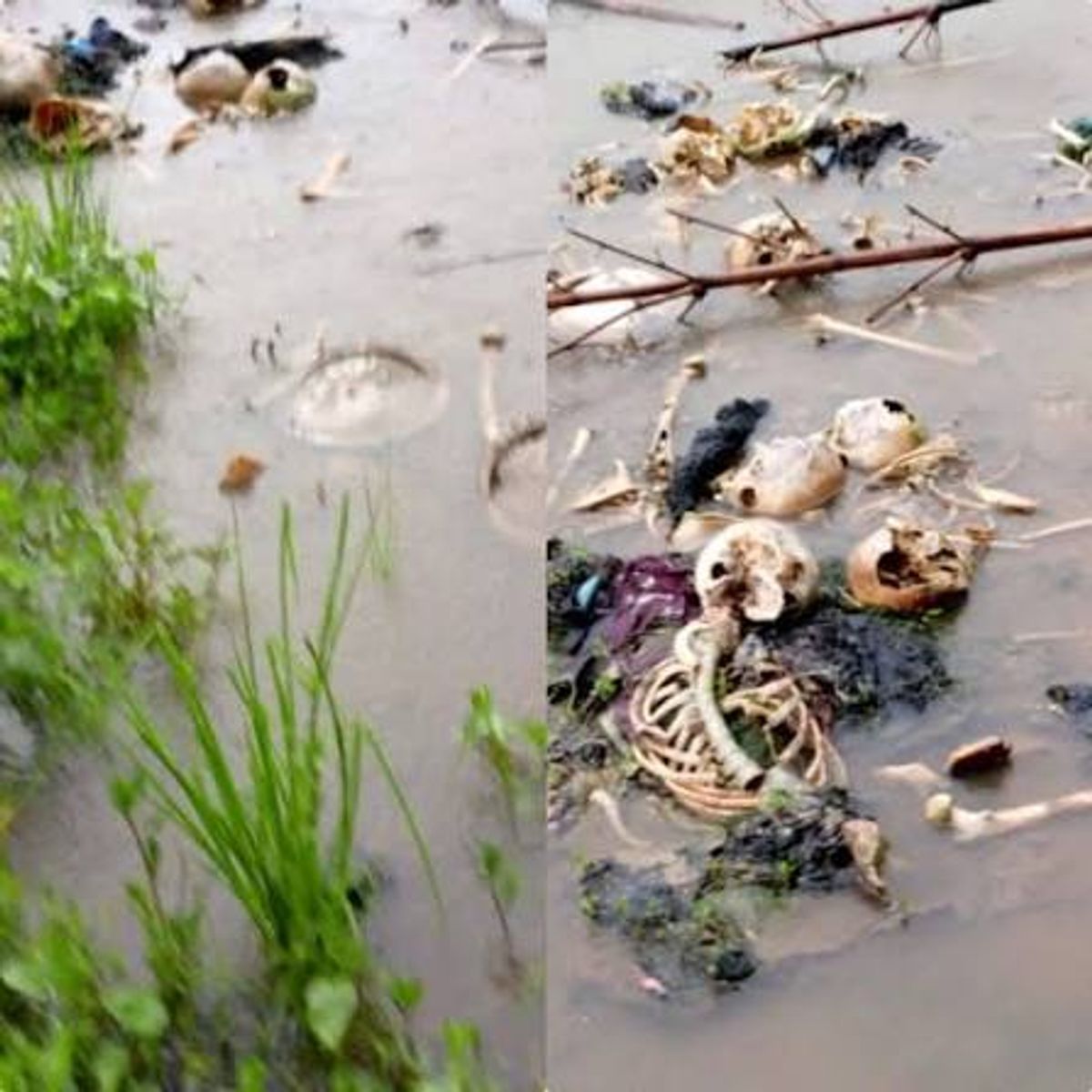
Fortify Rights documented multiple killings of Rohingya civilians in AA-controlled detention facilities, including five apparent beheadings. A mobile phone video on file with the organisation shows five bodies in a small pond, four of whom were beheaded. A UN Human Rights report confirmed the same incident, noting that five Rohingya men detained by the Arakan Army in northern Maungdaw on April 17, 2024, were later found with their bodies severely mutilated, four having been beheaded. [hrw](https://hrw.org/video-photos/video/2017/09/11/video-rohingya-describe-military-atrocities-burma)
One survivor described being beaten with bamboo sticks for approximately one and a half hours in an attempt to coerce a confession, and being kicked when he fell to the ground. While imprisoned in Buthidaung, he said he witnessed the Arakan Army removing dead bodies from cells at night. [hrw](https://hrw.org/video-photos/video/2017/09/11/video-rohingya-describe-military-atrocities-burma)
"The Arakan Army is responsible for widespread abductions, brutal torture and the murder of Rohingya, some of whom were found beheaded, in blatant violation of the laws of war," said Ejaz Min Khant of Fortify Rights. [hrw](https://hrw.org/video-photos/video/2017/09/11/video-rohingya-describe-military-atrocities-burma)
The Naf River Massacre, August 2024
On August 5, 2024, nearly 200 people were reportedly killed following drone strikes and shelling on Rohingya civilians fleeing fighting in Maungdaw near the Bangladesh border. A 24-year-old man told Human Rights Watch: "We made our way to the riverbank to cross, where thousands of people were making the journey. Suddenly, drones appeared and started dropping bombs on the crowd. In our group of 70 to 80, close to 20 were killed." [Wikipedia](https://en.wikipedia.org/wiki/Rohingya_genocide)
"The Naf River was full of dead Rohingya bodies as we fled," said another survivor, 18, whose father was killed in a drone attack that same day.
The following day, August 6, Arakan Army soldiers shot dead dozens of fleeing Rohingya civilians along the border in Maungdaw Township. A 10-year-old Rohingya girl shot by an AA soldier that day was later treated at a humanitarian hospital in Cox's Bazar. [Human Rights Watch](https://www.hrw.org/news/2024/08/12/myanmar-armies-target-ethnic-rohingya-rakhine)
Forced Labour and Forced Recruitment
Human Rights Watch said the Arakan Army has accompanied its territorial gains with movement restrictions, pillage, arbitrary detention and unlawful forced labour and recruitment against Rohingya civilians. "The Arakan Army is carrying out policies of oppression against the Rohingya similar to those long imposed by the Myanmar military in Rakhine State," said Elaine Pearson, Asia director at Human Rights Watch. [Human Rights Watch](https://www.hrw.org/news/2024/08/22/myanmar-new-atrocities-against-rohingya)
A 19-year-old Rohingya man who spent five months with the Arakan Army after being abducted for forced labour said Rohingya were regularly sent to the front line as human shields. "If anyone resisted, they were beaten and mocked," he said. "We asked if we could be treated equally. They said they'd treat us like the Burmans did," calling them by a slur used against Muslims. [Human Rights Watch](https://www.hrw.org/news/2024/08/22/myanmar-new-atrocities-against-rohingya)
"At least 2,500 Rohingya have been killed, and at least 40,000 have been forced to flee the country between March and August 2024 alone," said Nay San Lwin, co-founder of the Free Rohingya Coalition. [pressreader](https://www.pressreader.com/malaysia/the-star-malaysia/20181221/281870119545659)
No Accountability, No Return, No Justice
Fortify Rights has called on the International Criminal Court to investigate the Arakan Army for serious crimes in Rakhine State, noting that the court already has jurisdiction to investigate forced displacement and related crimes against the Rohingya. The Arakan Army has denied responsibility for civilian killings and said it would facilitate inquiries by credible independent groups, a commitment rights organisations say has not been honoured. [hrw](https://hrw.org/video-photos/video/2017/09/11/video-rohingya-describe-military-atrocities-burma)
Human Rights Watch said that conditions do not currently exist for the safe, sustainable and dignified return of Rohingya refugees to Rakhine State, whether the Myanmar military or the Arakan Army controls the area. [Europa](https://fpi.ec.europa.eu/news/rohingya-victims-confront-myanmar-military-genocide-case-2026-02-10_en)
For the survivors themselves, that conclusion is not a policy finding. It is the reality of their daily lives.
"We are not recovering," one survivor said. "We are just surviving. And there is a difference."
Survivor testimonies cited in this article were gathered by human rights researchers and submitted for documentation purposes. Battlefield claims by the Arakan Army have not been independently verified. Reporting on AA atrocities is based on investigations by The Daily East, Human Rights Watch, Fortify Rights, The New Humanitarian and UN OHCHR.


